When a saree has an all-over woven pattern, choose the blouse by its texture as well as its colour. A blouse can match the border perfectly and still compete with the body if both surfaces carry equally strong decoration.
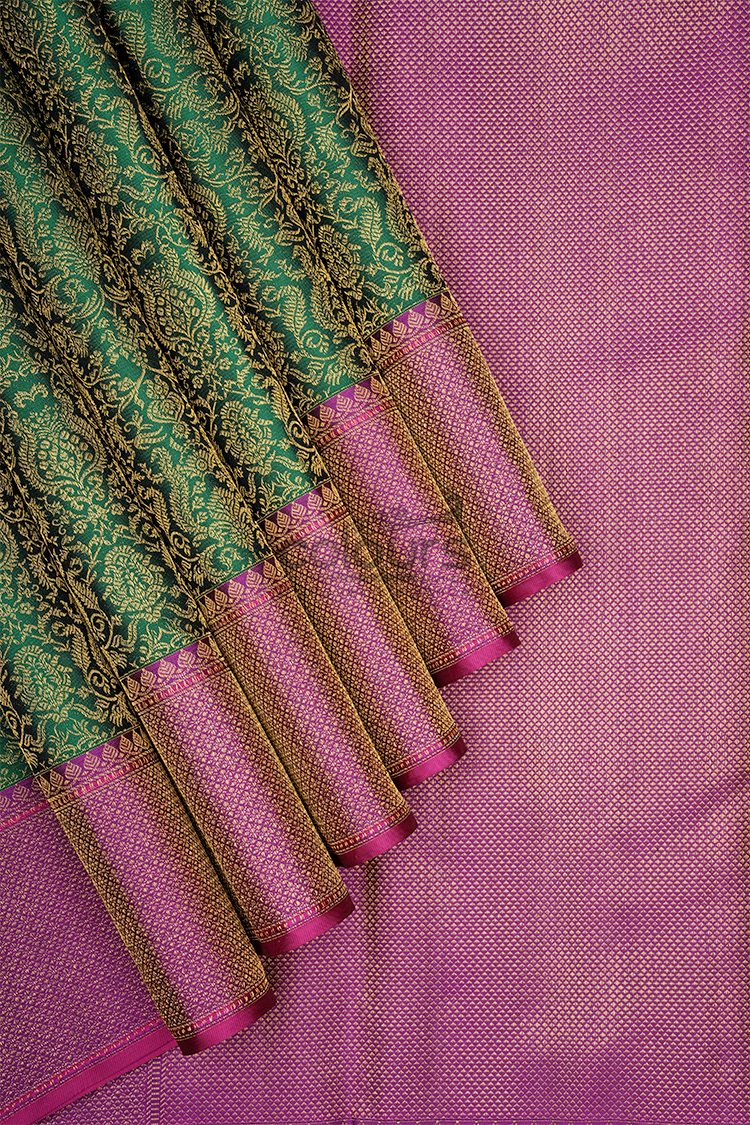
The CB001 – 207026-BL Colours Arani Kanchipuram Silk Saree combines emerald green with antique-gold floral and paisley jacquard across the body. A royal-magenta-and-gold border adds contrast. This makes it a useful design for learning how to balance pattern without removing the festive richness that attracted you.
Notice how much of the body is patterned
This is not a plain body with a single decorative corner. The description identifies an all-over weave containing floral, paisley, vine and ornamental forms.
Begin with a whole-saree view so you can judge the density of the design. A close-up helps you appreciate detail, but may not show how continuous the pattern feels across a larger area.
If you enjoy richly decorated clothing, that continuity may be the appeal. If you usually wear plain fabrics, consider whether you want the saree to supply most of the outfit’s pattern.
Your answer will guide the blouse more effectively than a rule that all festive clothing must be heavily embellished.
Try a plain surface before adding another pattern
A plain blouse in a compatible emerald or magenta gives you a clear baseline. Emerald can connect with the body; magenta can repeat the border.
Place both possibilities beside the saree if available. The blouse colour and the blouse surface are separate decisions. You may prefer a contrasting colour but a quiet texture.
A plain surface does not have to look unfinished. Fit, sleeve shape and neckline can give the blouse definition without an additional printed or embroidered design.
Confirm what blouse fabric is supplied, if any, before commissioning a separate garment.
Compare texture at the scale it will be worn
A subtle texture on a fabric swatch may look busier when used across an entire blouse. Equally, a textured blouse may appear relatively quiet beside a detailed saree.
Hold a sufficiently large area of the blouse fabric next to the saree rather than comparing tiny scraps. Look at the relationship from a normal conversational distance.
Ask which surface catches your attention first. If the blouse repeatedly draws attention away from the jacquard you wanted to feature, try a quieter option.
This is not a ban on texture. It is a way of deciding whether the second surface contributes something useful.
If you want pattern mixing, give the patterns different roles
You can deliberately combine patterns, but make the decision clear. A small repeated blouse pattern may create a different effect from another large floral design.
Avoid assuming that two paisley patterns will automatically coordinate because they share a name. Their scale, spacing, colour and finish can still differ.
Try the pieces together in the intended drape. A patterned sleeve may remain visible while a patterned front is largely covered, changing the balance you saw when the fabrics were laid flat.
If the result feels confused, simplify one element rather than buying more accessories to connect everything.
Edit the border, jewellery and bag as a group
The magenta border is already a strong colour contrast. Repeating magenta in one supporting item can make the palette coherent, but repeating it in every accessory is not essential.
Antique-gold weaving offers a possible connection to jewellery, yet a full statement set may create more decoration than you want. Try one prominent piece, then assess whether anything else is needed.
A smooth bag surface can provide a resting point beside the jacquard. A heavily patterned bag introduces another design that should be judged deliberately.
Use the saree styling guide for broad outfit principles. The specific challenge here is balancing an all-over patterned body with the rest of the outfit.
Match the visual richness to the event
This emerald-and-magenta design may appeal for a festive evening, a formal family gathering or another occasion where you enjoy a more elaborate appearance.
It may not fit a request for very understated dressing, even with plain accessories. A quieter blouse can balance the saree but does not remove its all-over pattern.
For India and Singapore celebrations, follow the actual invitation and your own taste. Neither country has a single correct level of decorative detail for Diwali or Deepavali.
Plan the outfit around how long you will wear it and the activities involved. Pattern density does not establish weight, coolness or ease of draping.
Make the final comparison simple
Photograph two complete blouse options if that helps you decide. Keep the jewellery and bag the same so you can see what changing the blouse actually does.
Choose the version in which the elements feel connected and you remain comfortable. You do not need the most elaborate option to justify a festive purchase.
Explore the saree collection if you prefer a plain body with decoration concentrated at the border instead.
Frequently asked questions
Must I wear a plain blouse with jacquard?
No. It is a useful starting point, not a rule. Compare patterned options deliberately if you enjoy them.
Does matching the magenta border guarantee a good combination?
No. Texture, pattern scale, fit and shine also affect the result.
Is the body pattern printed?
The description identifies an all-over jacquard weave. Use the stated product detail rather than assuming a print.
Can I wear statement jewellery too?
Yes, if you like the complete effect. Try one statement element first and add others only if they improve the balance.
Let the jacquard lead
View the emerald CB001 – 207026-BL saree and compare its full pattern with the blouse textures you are considering for your festive outfit.