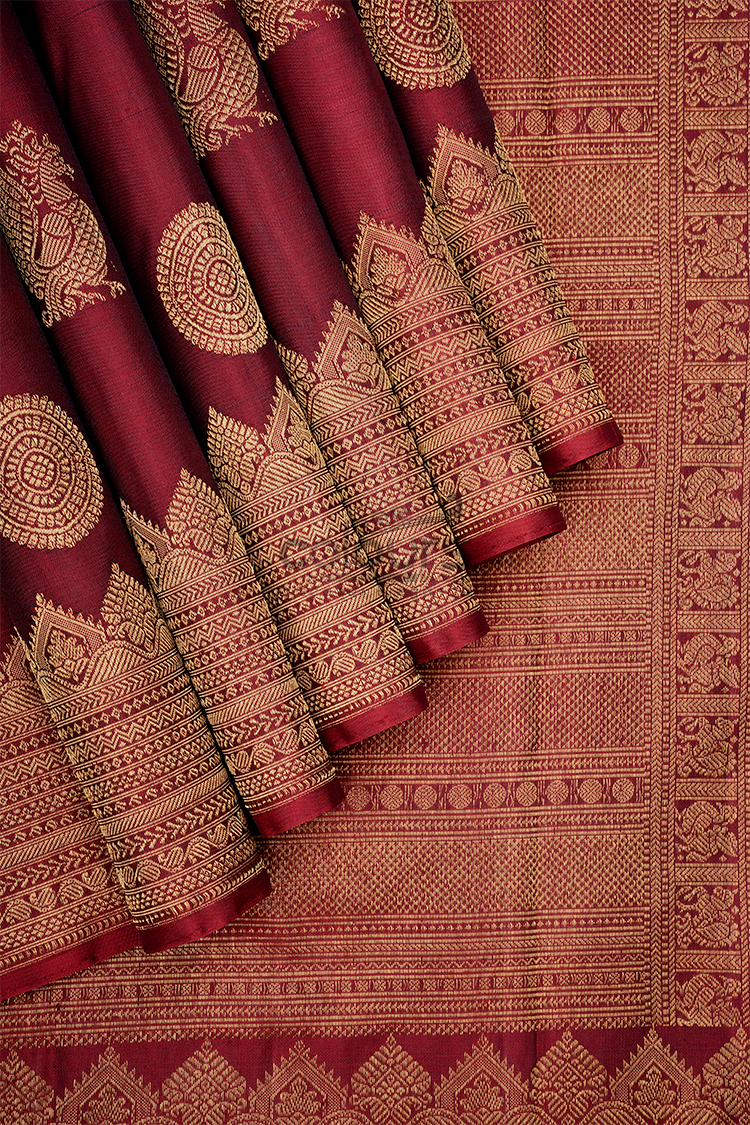
A temple-inspired border describes a visual design direction. It does not, by itself, prove where a saree was woven, establish a certification or prescribe where the garment must be worn.
The CB001 – 209002-KO Colours Arani Kanchipuram Silk Saree combines maroon with antique-gold peacock and floral butta. Its border is described with temple-inspired, floral and geometric patterns. Reading these details carefully helps you choose a festive saree for its actual appearance while keeping separate claims in their proper place.
Identify the three design areas
Start with the maroon body, then look at the smaller butta and finally the border. This separates the colour foundation from the repeated decorative forms and the framing detail.
The product description identifies peacock and floral butta on the body. It also describes a more elaborate border combining several pattern types. Do not assume the body and border repeat exactly the same motifs.
A whole-saree photograph helps you judge their balance. Close-ups help you inspect individual shapes, but can make a smaller section appear more dominant than it will be when worn.
Ask for another image if you cannot distinguish a motif clearly. It is better to use the listing’s stated description than to invent a more specific name from an unclear photograph.
Understand what “temple-inspired” means here
In this listing, temple-inspired refers to the border’s visual pattern. You can appreciate the architectural association without assigning a particular temple, region or historical period.
If a precise design origin matters to you, ask the boutique for documentation or a more detailed explanation. A product name and a decorative resemblance are not substitutes for that evidence.
The description also includes floral and geometric elements. The border should therefore be viewed as a combination, rather than reduced to one symbolic label.
This makes the article useful for Diwali shopping without turning it into a guide to religious dress requirements. Your household or venue’s customs remain a separate consideration.
Keep material claims separate from motif names
The product specification lists pure silk and zari weaving. Those are the catalogue’s stated material and work details.
A gold-coloured appearance does not establish the precious-metal content of the zari. Likewise, a temple or peacock motif does not independently prove handweaving, geographical origin or certification.
If any of those factors is decisive for your purchase, request the relevant product-specific evidence. Avoid relying on a general website badge or the reputation of a design category alone.
This distinction does not diminish the visual appeal of the saree. It simply helps you buy for reasons you can explain clearly.
Decide how much pattern you want to show
Maroon gives the gold details a defined background. A blouse that continues the maroon can keep the relationship between body and border clear.
If you prefer a gold-toned blouse, compare its finish with the actual zari. A very reflective surface may compete with the finer motifs. A quieter texture may allow those details to remain more noticeable.
The butta already create repeated points of interest. Jewellery does not need to imitate the peacock or floral forms. A simple shape can complement the pattern without making the outfit depend on a matched theme.
Try the complete drape before deciding how open the pallu should be. Comfortable placement matters more than displaying every woven area simultaneously.
Choose the occasion through your own plans
This maroon-and-gold design may appeal for a family Deepavali gathering or a more formal festive occasion where you enjoy traditional decorative detail.
If you are attending a temple, check that venue’s guidance separately. A temple-inspired pattern does not make the garment automatically suitable for every location or activity.
In India and Singapore alike, family preferences and event formality vary. There is no need to invent a country-wide rule for maroon, gold or peacock motifs.
For broader context, read the South Indian saree guide. For this purchase, return to the actual product photographs and the details that matter to you.
Ask useful questions before ordering
Instead of asking only whether the saree is “traditional,” ask about the features behind your decision. You might need a full border photograph, dimensions, blouse-piece information or product-specific care instructions.
If the motif layout is central, ask how it appears in a draped view. If a certification is central, ask for the evidence attached to this item. Different questions require different answers.
Compare alternatives in the saree collection if you want a quieter border or a different balance between body and butta.
A clear purchase decision might be as simple as enjoying maroon with gold peacock detail. It does not need an unsupported historical story to be meaningful.
Frequently asked questions
Does a temple-inspired border prove the saree’s origin?
No. It describes the design. Origin or provenance requires separate product-specific evidence.
Are the gold motifs necessarily made from pure gold zari?
No. Colour and the word “zari” do not establish precious-metal content.
Must this saree be worn for a temple visit?
No. The pattern does not restrict the garment to a particular occasion. Choose according to your preferences and the event.
Can I wear plain jewellery with a detailed border?
Yes. Simpler jewellery can leave the body motifs and border easier to appreciate.
Explore the maroon-and-gold design
View CB001 – 209002-KO to compare its peacock butta, floral details and border as one complete festive design.