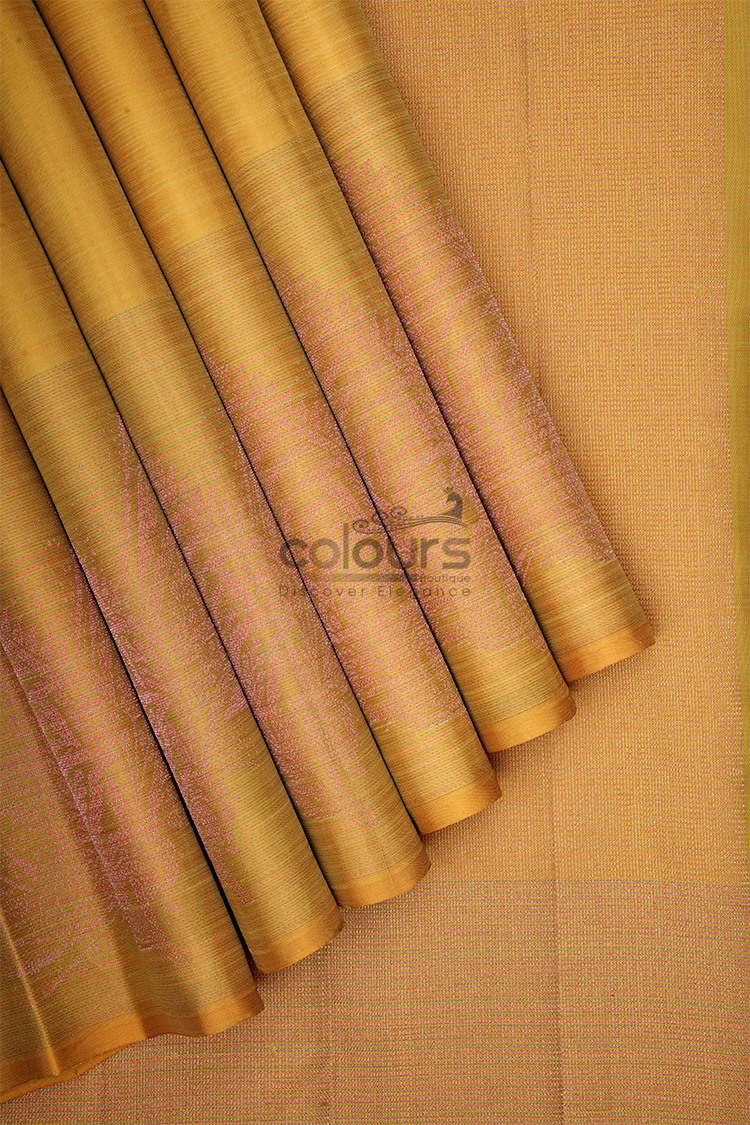
A mustard gold self-tone saree can feel festive without relying on a strong contrast border or an all-over metallic statement. The useful distinction is between colour, texture and shine: you can enjoy a warm celebratory colour while keeping the overall outfit quiet.
Colours Arani Kanchipuram Silk Sarees – CB001 – 2015013-BL brings that approach into focus. Its description identifies a mustard gold body, fine self-woven texture and a large botanical jacquard motif in a similar tone. Here is how to decide whether that kind of detail belongs in your Diwali wardrobe.
Decide what “understated” means to you
For one shopper, understated means fewer colours. For another, it means smaller jewellery or a blouse without embroidery. Before comparing sarees, identify which part of a festive outfit usually feels excessive to you.
If you dislike strong colour contrasts, this design’s tonal botanical motif is a useful starting point. If you dislike any visible pattern, however, a large motif may still feel decorative even when it blends with the body. Look at its scale, not just its colour.
The mustard shade itself also matters. A restrained pattern does not turn a warm yellow-gold colour into a neutral. Choose it because you enjoy the colour, rather than expecting it to disappear into the background.
Read the botanical detail at two distances
Start with the full product photograph. Ask whether you notice the overall mustard colour first or the botanical form. Then inspect the closer image to understand the woven texture.
These two views answer different questions. A close-up helps you appreciate the design; a full view helps you imagine the whole outfit. Avoid making the purchase from a detail photograph alone, particularly if your priority is a quiet appearance.
Once you receive the saree, arrange it in your intended drape before finalising accessories. The visible area of a large motif depends on where the fabric sits. You do not need to expose the entire design at the expense of a comfortable arrangement.
Let the blouse supply structure
A plain blouse in a compatible mustard shade can create a continuous colour story. Compare the actual fabrics: mustard may lean yellow, ochre or brown, and identical colour names do not guarantee a match.
An earthy brown blouse is another styling possibility if you prefer some definition. It introduces contrast, so judge whether that still fits your original reason for choosing a tonal saree.
Blouse texture is particularly important here. A very shiny surface can draw more attention than the botanical weaving. Try a quieter surface first, then compare a more reflective option only if you want the blouse to become a feature.
Choose the neckline and sleeve shape for your own fit and movement. A clean outline can provide enough structure without an embroidered panel. Confirm blouse-piece inclusion separately before planning tailoring.
Build a complete outfit from what you own
Lay out the saree with one comfortable blouse, one jewellery option and one bag. This is a wardrobe exercise, not a requirement to buy a matching set.
A small pair of earrings may be sufficient if you want the botanical motif to remain the decorative focus. A necklace can also work, but compare its shape with the visible motif rather than adding it automatically.
Use the same approach for the bag. A quiet finish supports the tonal effect; a heavily embellished clutch changes the emphasis. Neither is inherently wrong, but each produces a different outfit.
If the saree needs several new purchases to feel right, include those in your decision. The most useful festive purchase is often the one that connects naturally with clothing and accessories you already enjoy.
Choose an occasion that welcomes this mood
This design may appeal for a family lunch, a smaller Deepavali gathering or a workplace celebration where a restrained outfit feels appropriate. It may be less aligned with your preferences if you specifically want a very strong contrast or an ornate visual centrepiece.
For Singapore celebrations, assess the actual journey and room conditions. A quiet-looking saree is not automatically cool to wear. For India, consider your city, venue and the length of the occasion rather than assuming one climate or dress expectation.
The listing specifies pure silk. That describes the stated material; your blouse, supporting layers, fit and personal experience still affect comfort. Ask for details you need before purchasing.
Make a deliberate buying decision
Use the online saree buying guide for the broader checks, then return to three design questions: do you like mustard, do you want a large tonal motif, and can your existing wardrobe support it?
Compare alternatives in the saree collection if one answer is no. You do not have to choose a brighter or more ornate design simply because the occasion is Diwali.
Frequently asked questions
Is mustard gold the same as a metallic gold saree?
No. Here, mustard gold describes the colour, while the product description identifies self-woven texture and a tonal botanical motif. Do not infer a metallic all-over finish from the colour name.
Does a self-tone motif mean the saree is completely plain?
No. A pattern can remain visible through its shape and texture even when its colour is close to the surrounding fabric.
Must I buy a matching mustard blouse?
No. A compatible existing blouse may work. Compare it against the actual saree and confirm any included blouse fabric separately.
Is this saree suitable for every office event?
No. Your workplace’s dress expectations and your comfort should guide the decision. The understated styling approach is an option, not a universal dress code.
Explore the tonal approach
If warm colour and botanical texture suit your style, view CB001 – 2015013-BL and compare its full photographs before choosing your festive combination.