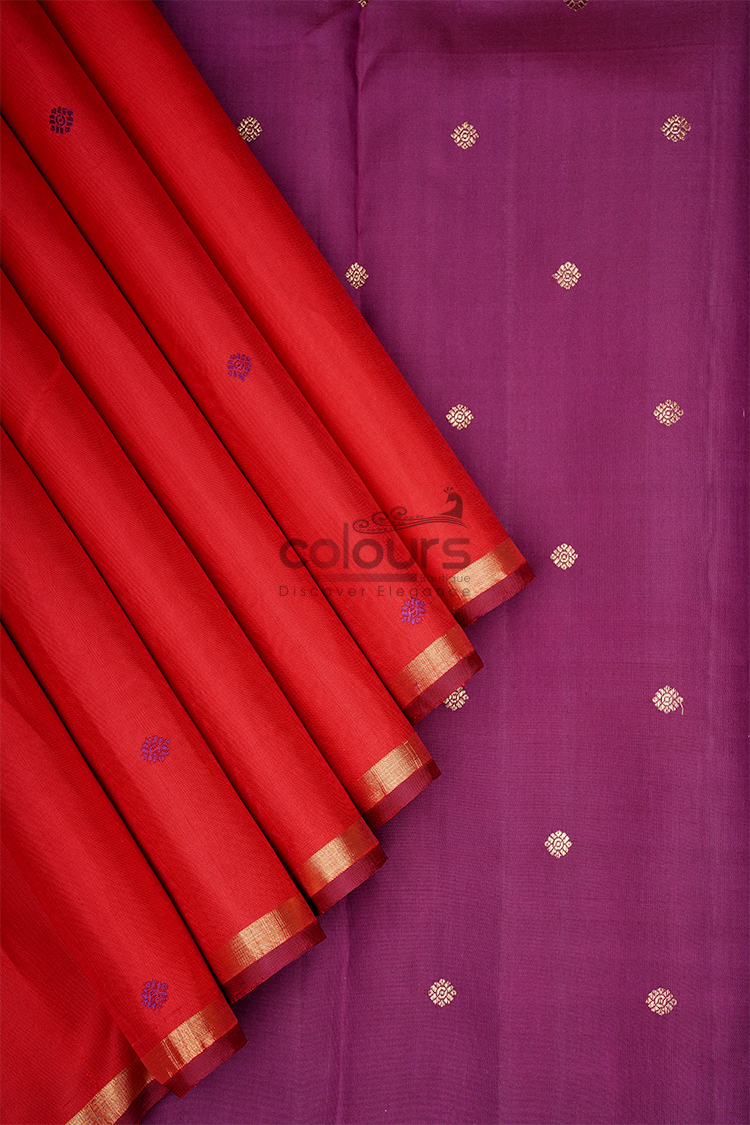
A couple’s festive outfits can feel connected without using identical colours or matching fabrics. With a ruby red saree carrying purple details, repeating one smaller accent in the other person’s outfit is often a useful starting point.
The CB001 – 6001-BL Colours Arani Kanchipuram Silk Saree combines a ruby-red body with deep-purple woven butta and an antique-gold zari border finished with a purple edge. That provides several ways to coordinate for Diwali while allowing both people to keep their own style.
Agree on the level of formality first
Before comparing colours, decide what kind of event you are attending. A relaxed meal at home and a formal evening reception may call for different clothing even when the palette stays the same.
Each person should feel appropriately dressed for the invitation. A heavily formal outfit beside a very casual one can feel less connected than two different colours worn at a similar level of formality.
Ask what both people already own and enjoy wearing. There is no need to make one person’s outfit a costume built around the other’s. The shared colour should be an easy connection, not an obligation to buy a complete new wardrobe.
Use purple as a small shared accent
The purple butta and border edge offer a less obvious coordination route than matching the ruby body. A partner could repeat a compatible purple in a garment or a small accessory they would genuinely wear.
The size of that accent matters. A large purple area creates a strong two-colour pairing; a smaller detail produces a subtler link. Compare both beside the saree rather than judging the second outfit alone.
Purple shades vary considerably. A bright violet may look different from the saree’s deep-purple tone. Exact duplication is not necessary, but the relationship should look deliberate in person.
Any partner garment or accessory is a separate styling choice. It is not part of the saree purchase.
Try a quieter supporting outfit
If neither person wants a purple accent, a quieter supporting palette can give the ruby saree room to lead. Consider clothing already owned in a compatible neutral, then compare the complete outfits.
The aim is not to make one outfit invisible. Shape, texture and fit can give each person a clear presence even when one uses stronger colour.
Avoid adding a gold accessory solely because the saree has antique-gold zari. A small connection may be useful, but multiple metallic items can make the coordination look more formal than intended.
If both people prefer stronger colour, try the combination and judge it together. A coordinated look is a shared decision rather than a fixed colour formula.
Make the saree blouse part of the pair
A ruby blouse can continue the body colour, while a compatible purple blouse can emphasise the smaller woven details. Decide this before finalising the partner’s accent.
For example, a purple blouse already creates a larger purple area. Adding another large purple garment may make that shade dominate the pair. If the blouse is ruby, a smaller purple accent elsewhere may be more noticeable.
This is why laying out only the saree and the second outfit can be misleading. Include the actual blouse, jewellery and shoes where relevant.
Confirm blouse-piece inclusion and allow time for fitting. Do not treat the pictured styling as a complete outfit supplied with the product.
Compare together in ordinary light
Stand side by side in daylight and in a room with lighting similar to the celebration venue. Look at the relationship between the outfits rather than trying to judge a perfect colour match.
Take a simple reference photograph if helpful. Check whether a reflective surface draws unexpected attention or whether a colour that looked coordinated separately clashes when the outfits are next to one another.
Choose one change at a time. Swapping a small accessory may be enough; changing every component at once makes it harder to understand what improved the combination.
For more general colour considerations, the saree colour guide offers a starting point. Here, the specific task is creating a connection between two people.
Prepare for India or Singapore plans
If the two outfits are being purchased in different places, compare physical items together before the event when possible. Screen photographs are useful for discussion but are not exact colour samples.
For a Singapore Deepavali event, check whether your plans include outdoor travel and an indoor gathering. For an India celebration, account for your actual venue and local conditions. Each person’s comfort matters independently.
If one outfit is delayed, simplify the coordination using existing clothing. An unconfirmed delivery date should not force a last-minute purchase purely to preserve a colour scheme.
Explore the saree collection if ruby and purple do not connect naturally with either wardrobe.
Frequently asked questions
Must a partner wear red?
No. Purple details or a compatible quieter palette can create a connection without matching the saree’s main colour.
Should both outfits use the same fabric?
No. Similar formality and a considered palette matter more than identical materials.
Can we coordinate using only an accessory?
Yes, if that accessory suits the wearer and is visible enough to create the connection you want.
Does the saree include a matching blouse or partner outfit?
Do not assume either. Confirm blouse details with the boutique; partner clothing is a separate styling choice.
Build a shared palette
View the ruby-and-purple CB001 – 6001-BL saree and use its body, butta and border edge as starting points for a pair of outfits that feels comfortable to both of you.