Choose jewellery for a Navaratri saree by deciding what should lead the outfit. If the woven motifs are the main feature, let accessories support them. If the saree is visually restrained, a necklace or earrings can become the statement.
This approach creates room for personal preference. It also helps you use pieces you already own rather than buying a complete matching set for every festive outfit.
Start with mustard gold and a silver Getti border
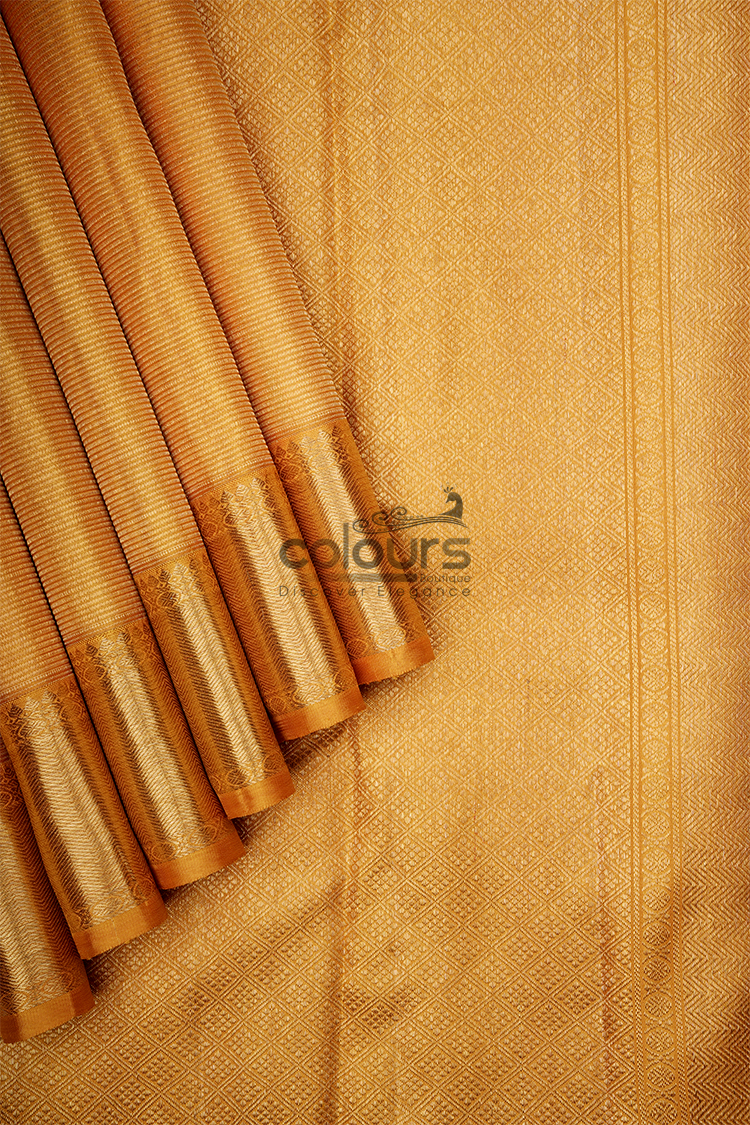
The CB001 - 502013-GB saree is listed in Getti Border. Its description identifies a mustard-gold self-tone body, a broad silver zari border and a zari pallu.
This warm-body and cool-metallic contrast gives shoppers in India and Singapore a different accessory direction from an all-gold look. Choose whether the silver border or body colour should lead.
Silver and gold here describe appearance. The product name does not establish independently verified precious-metal content, and coordinating jewellery need not be made from a particular metal.
Choose a necklace-led or earrings-led look
When the necklace leads
Compare the necklace with the blouse neckline and pallu placement. Choose a length that sits clearly instead of repeatedly slipping beneath the neckline.
Check whether it catches on the fabric when you turn or lean forward. A necklace that looks balanced while standing can behave differently when you sit.
With this mustard-gold design, silver-toned jewellery can echo the broad border, while a restrained warm-metallic accessory can support the body colour. Judge the complete scale rather than assuming that a broad border requires large jewellery.
When the earrings lead
Statement earrings can complete a festive direction while the neckline stays simple. This is useful if the blouse already has visible detail or if a necklace would cover an area you want to show.
Try the earrings with your hairstyle and pallu. Notice whether they catch in the hair or feel uncomfortable when you turn.
Choose pieces you can wear for the planned duration. An accessory that needs repeated adjustment can distract from the celebration even when you love its appearance.
Compare finish and shine
Two accessories described as gold can look quite different. One may be pale and reflective, another darker and less shiny.
Place them beside the saree and judge the whole combination. Exact matching is not compulsory, but the difference should feel deliberate to you.
Try silver-led earrings, a restrained warm-metallic necklace or a mixed-finish combination using pieces you own. Compare each with the mustard-gold body and visible silver border. You do not need equal amounts of both finishes to make the outfit feel connected.
These are options, not required purchases. Use the colour guide to decide the palette before assessing how much jewellery to add.
Keep hand accessories compatible with the activity
Bangles and bracelets can complete the look, but test them when holding a plate, using a phone or carrying a bag.
Avoid rough edges or loose settings that could catch on woven fabric. Examine a piece before wearing it rather than discovering the problem after it snags the pallu.
If hosting or travelling between several visits, you may find fewer hand accessories easier to manage. Earrings and one bracelet can still create a festive direction.
Check rings too. A projecting setting can catch during small everyday movements, especially when gathering the saree or opening a bag.
Select a bag as part of the outfit
Your bag needs enough capacity for the essentials you will carry. A decorative clutch that cannot hold them may be less useful than a slightly larger bag.
Check the strap, chain, closure and surface decoration for catching points. Notice where it sits beside the pallu and whether you can carry it comfortably.
If the bag becomes another statement piece, reduce an accessory elsewhere. A broad silver border, large necklace, statement earrings and decorated clutch may all compete for attention.
Edit the complete look
Put on the saree, blouse and main accessory first. Add smaller pieces only if they improve the result.
Take a full-length photograph and identify what you notice first. If several elements compete, remove one and compare again. Allow clear space around the detail you most enjoy.
For neckline planning, use the blouse guide; for occasion selection, return to the buying guide.
Use photographs as a comparison
Take one photograph with the main jewellery and another with one piece removed. Compare which version lets the saree detail remain visible. The point is not to find a universally correct amount of jewellery, but to see whether the choices support the focal point you intended. Keep the more practical version if both appeal equally.
Choose accessories for celebrations in India and Singapore
In India, match the scale of the jewellery to the specific ceremony or gathering rather than assuming every festival outfit needs a large set. In Singapore, consider the actual travel and venue arrangements when choosing pieces you will wear for several hours. These are individual itinerary choices in both countries. Silver-led accessories can echo this saree’s border in either setting; a mixed-finish look is also optional. Select pieces you already find comfortable and check their edges beside the fabric.
Frequently asked questions
Must jewellery match the zari exactly?
No. Compare the finishes together and choose a combination you enjoy.
Can both a necklace and earrings be statements?
Yes, if the complete look feels balanced and remains comfortable.
Is gold jewellery required?
No. Gold-toned styling is one visual direction, not a material requirement.
What deserves special attention around woven fabric?
Rough settings, loose chains and sharp edges that may catch.
Let the border guide the jewellery
Explore the mustard-gold Getti Border saree and compare accessories against its silver border before deciding.